Sun Life is a leading international financial services organization, offering a wide range of insurance, wealth, and health management solutions to millions of clients across Canada and globally. With a strong focus on fostering financial security and well-being, Sun Life is committed to delivering personalized services and empowering individuals and businesses with tools to achieve their health and financial goals. Their dedication to corporate responsibility and community involvement extends beyond just financial services, emphasizing overall well-being and a brighter, sustainable future for all.
About the project
About the project
The One Product Experience (1PX) initiative for Sun Life Connect (SLC) aimed to deliver a holistic experience by improving key areas that would add significant value for facility admins who manage providers across Canada. Initially, the project had a narrower scope, with a focus on increasing the percentage of provider accounts with more detailed information on Lumino Health. However, through a competitor analysis, the project pivoted towards a more comprehensive strategy. The key areas identified for improvement were the add-a-provider flow, homepage redesign, communication and notifications, intake forms, and coverage lookup. This approach ensured a more impactful and interconnected user experience for facility admins.
A critical component of this project was conducting thorough user research and creating a research plan. Moderated interviews with users (facility admins and providers) helped uncover insights that led to key design decisions. For instance, the research revealed that provider accounts were not seen as valuable by users, while the intake form was a highly requested feature. The research findings highlighted the importance of adding value through user-centric enhancements rather than focusing solely on individual features.
Center on a holistic approach to the (Sun Life Connect) SLC app, focusing on key areas to deliver significant value to our users.
Problem statement
How might we deliver more value to our users while also finding ways to clearly demonstrate that value to them?
Problems to solve
Education & Branding
We're not doing a good job to educate our facility admins on the value they have on SLC and how it affects their providers on Lumino search.
Inefficient home page
Users often overlook the features on the home page, and we don't effectively showcase the value of our offerings there.
80%+ LHPs
Entice our facility admins to update their provider profiles to increase the # of basic users to 80%+ Lumino Health Profiles (LHPs).
Add a provider features
Users have the option to opt in to either LHP or eClaims during add a provider flow. If they don't do it then, it's difficult for them to opt in later on.
Lack of communication
Our users complete certain tasks, but there isn't enough feedback or notifications to keep them updated on their progress or status.
Conceptualization, user research, crafting research plans, competitor analysis, user interview scripts, interviews along with synthesis, create user flows, create wireframes, designs, iteration.
The overall goal of One Product Experience (1PX) was to focus on a holistic experience to find several different key areas across
Sun Life Connect
(SLC)
to improve the value we offer to our users. However, early on the project was much smaller in scope. Business at that time was specifically looking to add a feature that would raise the % of provider accounts data to 80% or higher on SLC. Seekers would then find providers with more data while they use Lumino Health. So before I go into further detail 1PX, I would like to go over the competitor analysis I conducted that eventually took us to pivot into that direction.
Cross functional collaboration
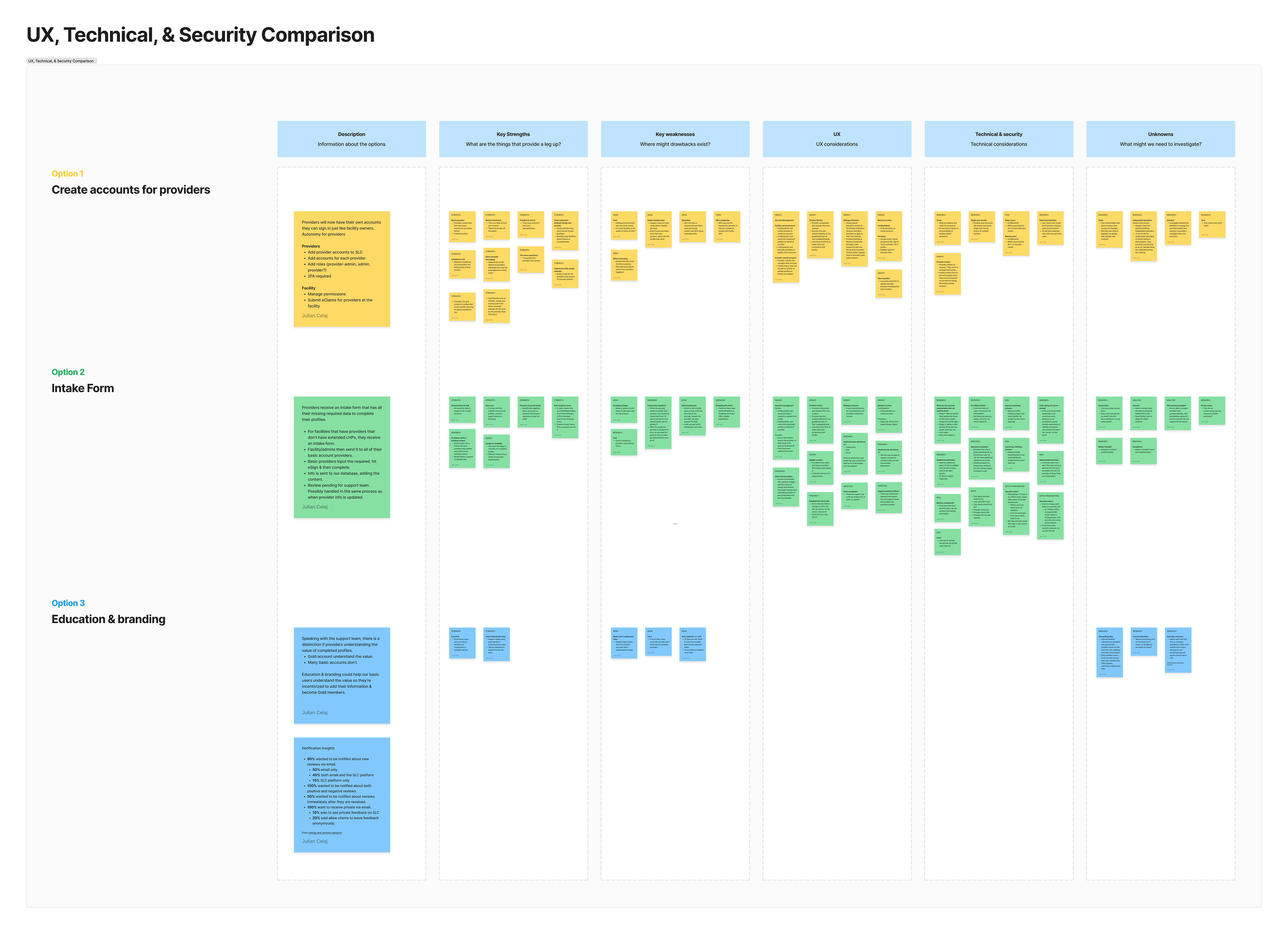
Throughout the process, I maintained constant communication and collaboration with the business, 2 support teams, development, and marketing teams to ensure everyone was updated on our progress and to incorporate their feedback. We later held a crucial meeting with the development lead, product manager, design team lead, and architect to address UX, technical, and security considerations. I presented a table outlining key business priorities that included provider accounts, intake forms, as well as education and branding. Based on the architect's feedback, the team leaned towards the intake form solution, as the provider accounts feature may have required possibly 2x more time and resources. The next step was to develop a detailed research plan before making a final decision.
Competitor analysis
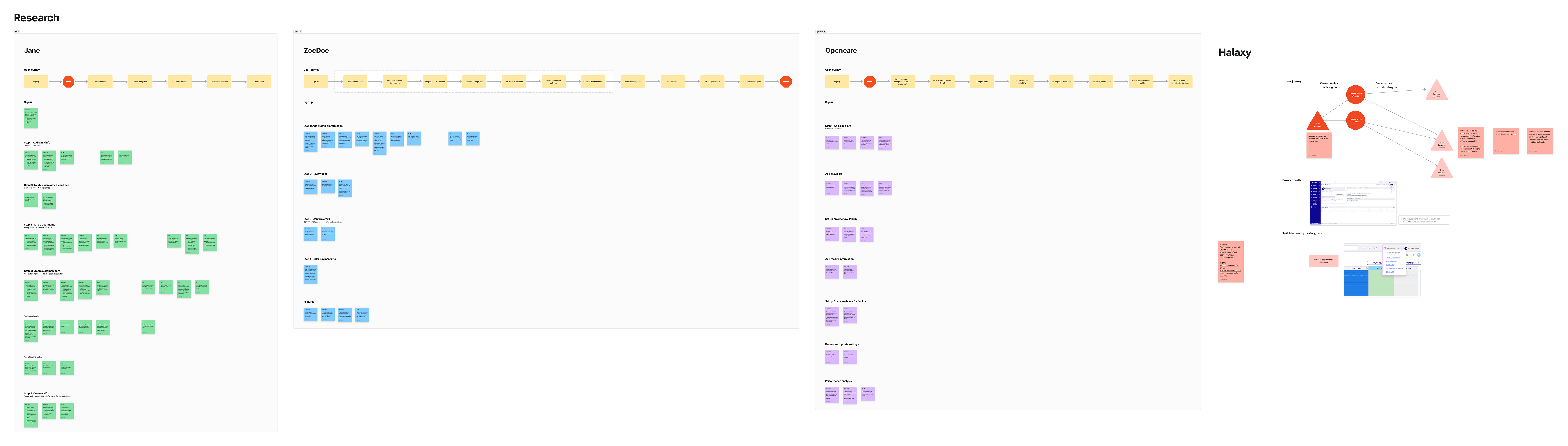
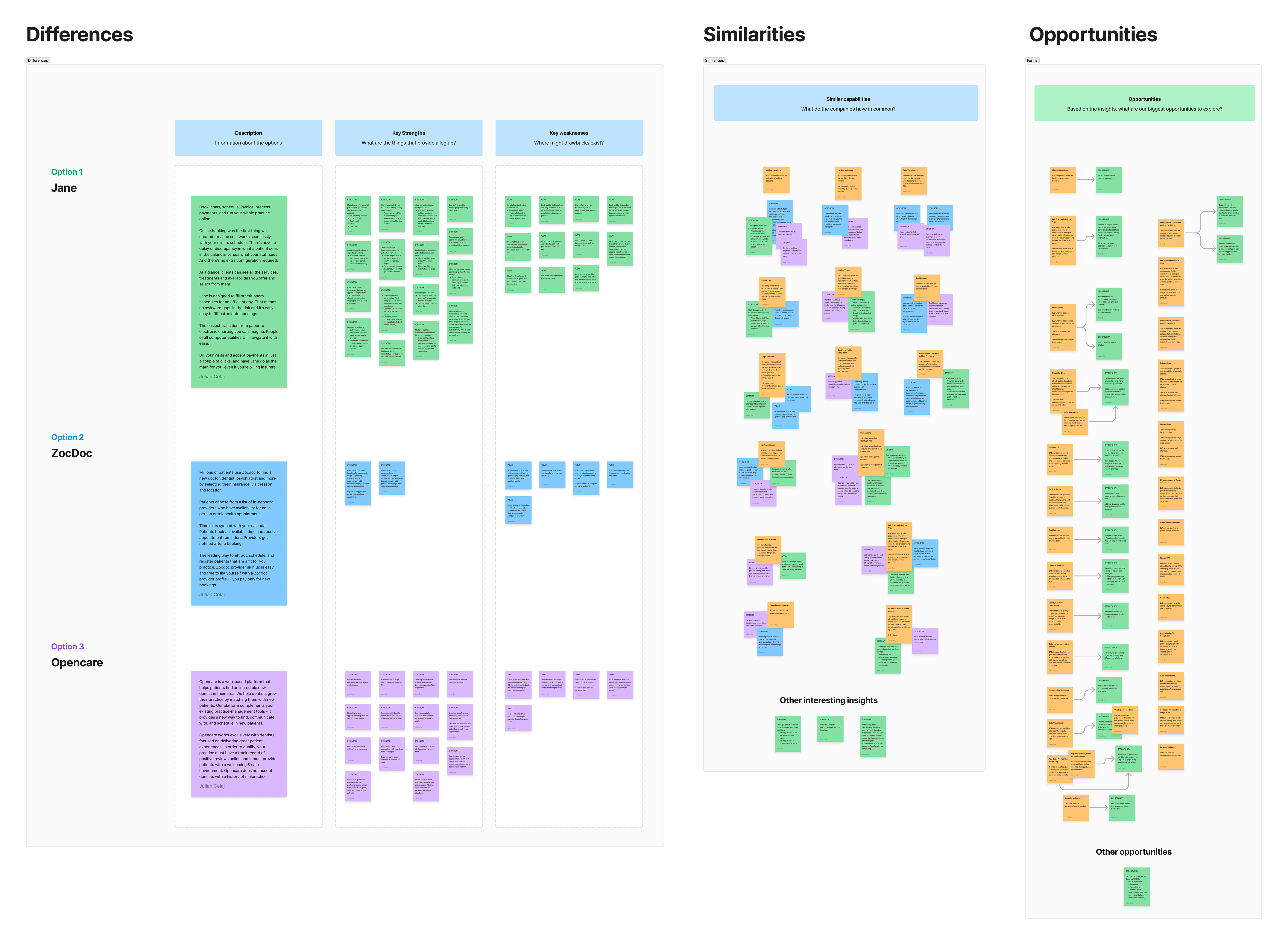
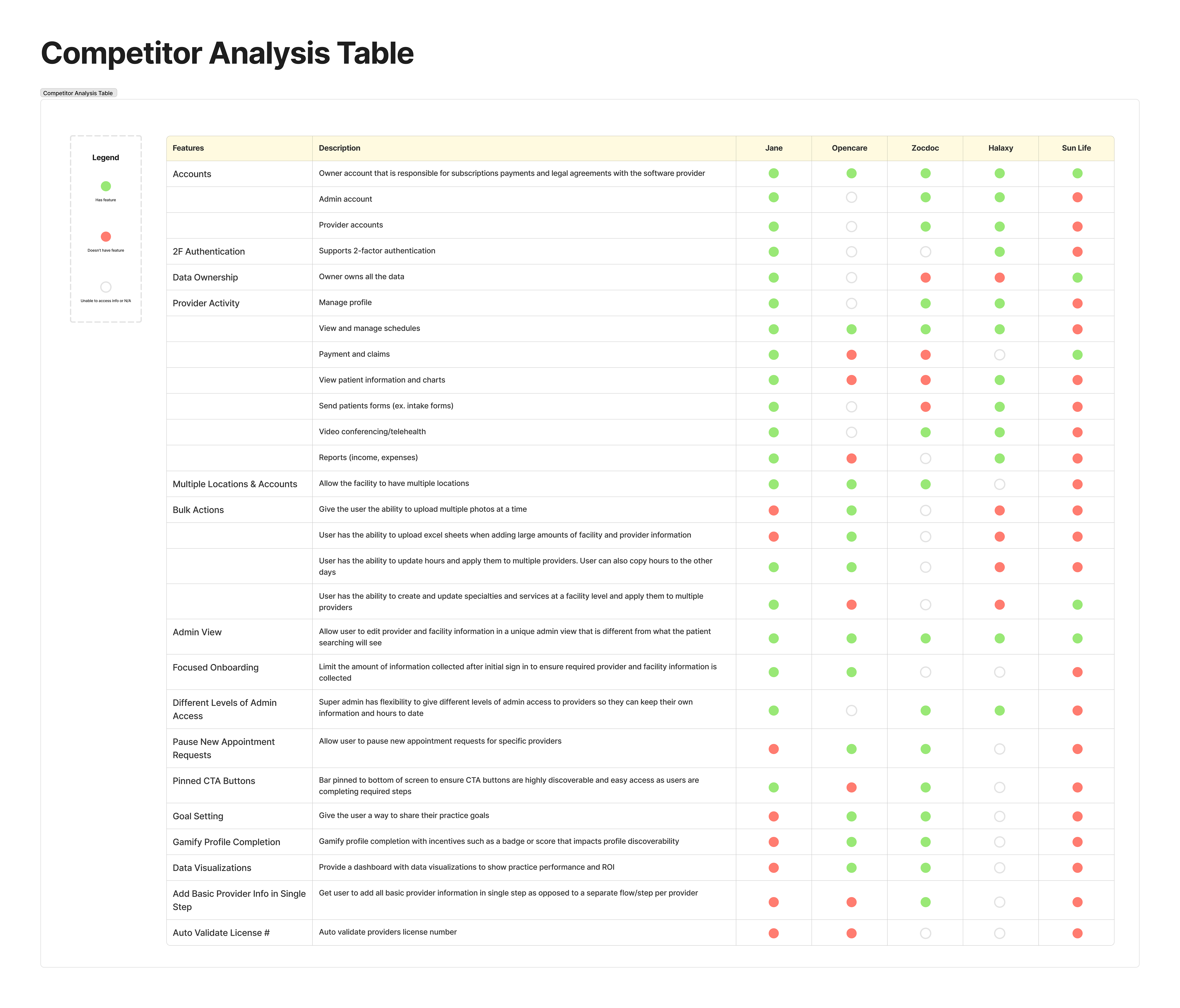
To identify features that could help raise basic accounts to 80% or higher completion, I conducted a detailed competitor analysis. I began by gathering data from key competitors such as Jane, ZocDoc, Opencare, and Halaxy (some of which we already had some information on) focusing on their strengths and offerings. The goal was to examine differences, similarities, and opportunities between them and Sun Life. This analysis provided valuable insights, allowing me to create a competitor comparison table that highlighted what competitors were doing effectively and what Sun Life was lacking. These findings helped guide our team in prioritizing potential features or categories that could elevate the platform and align with our goal.
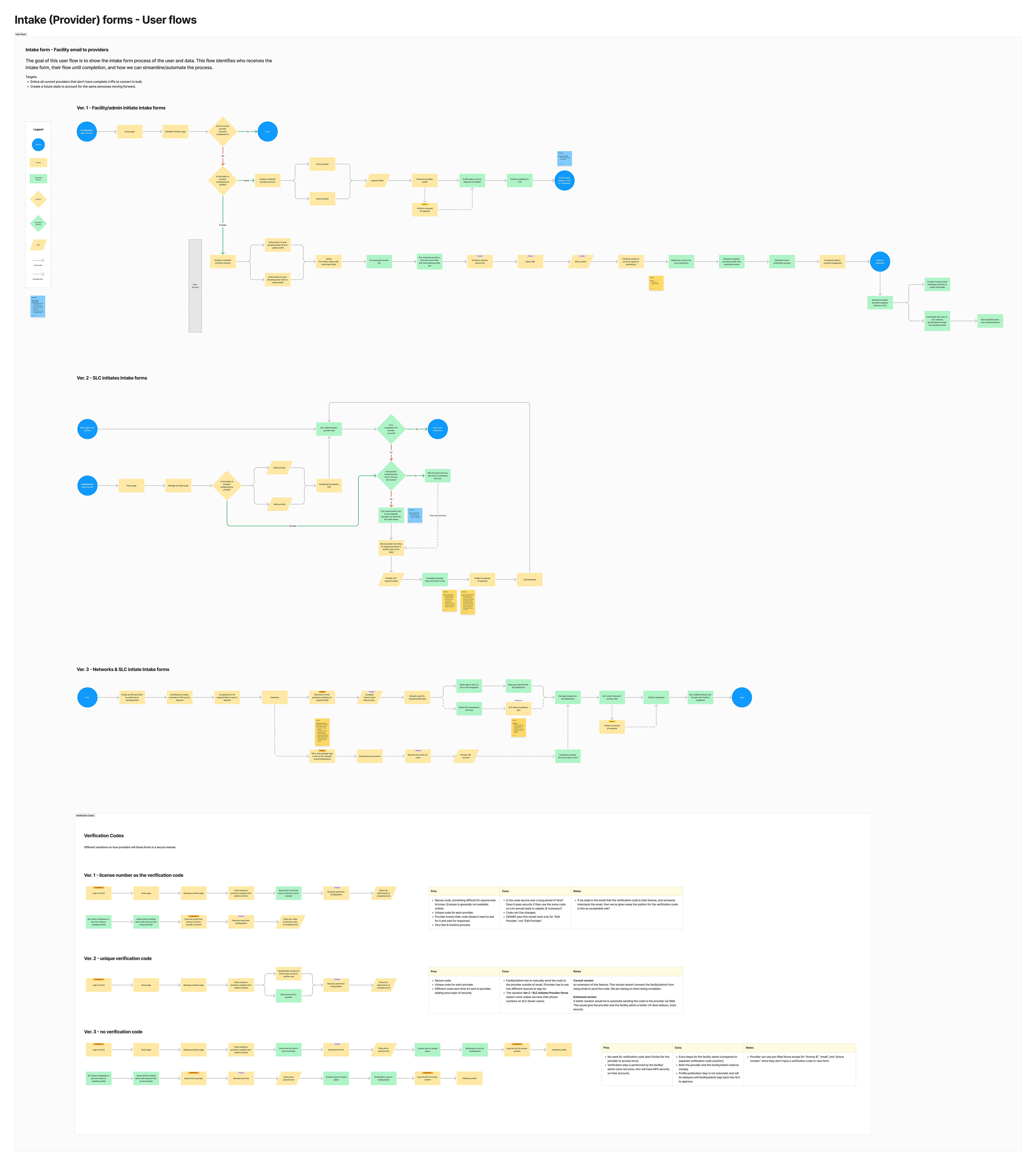
Three different user flows with verification code variants
Meeting with development, architect & business over feature plans
Intake forms
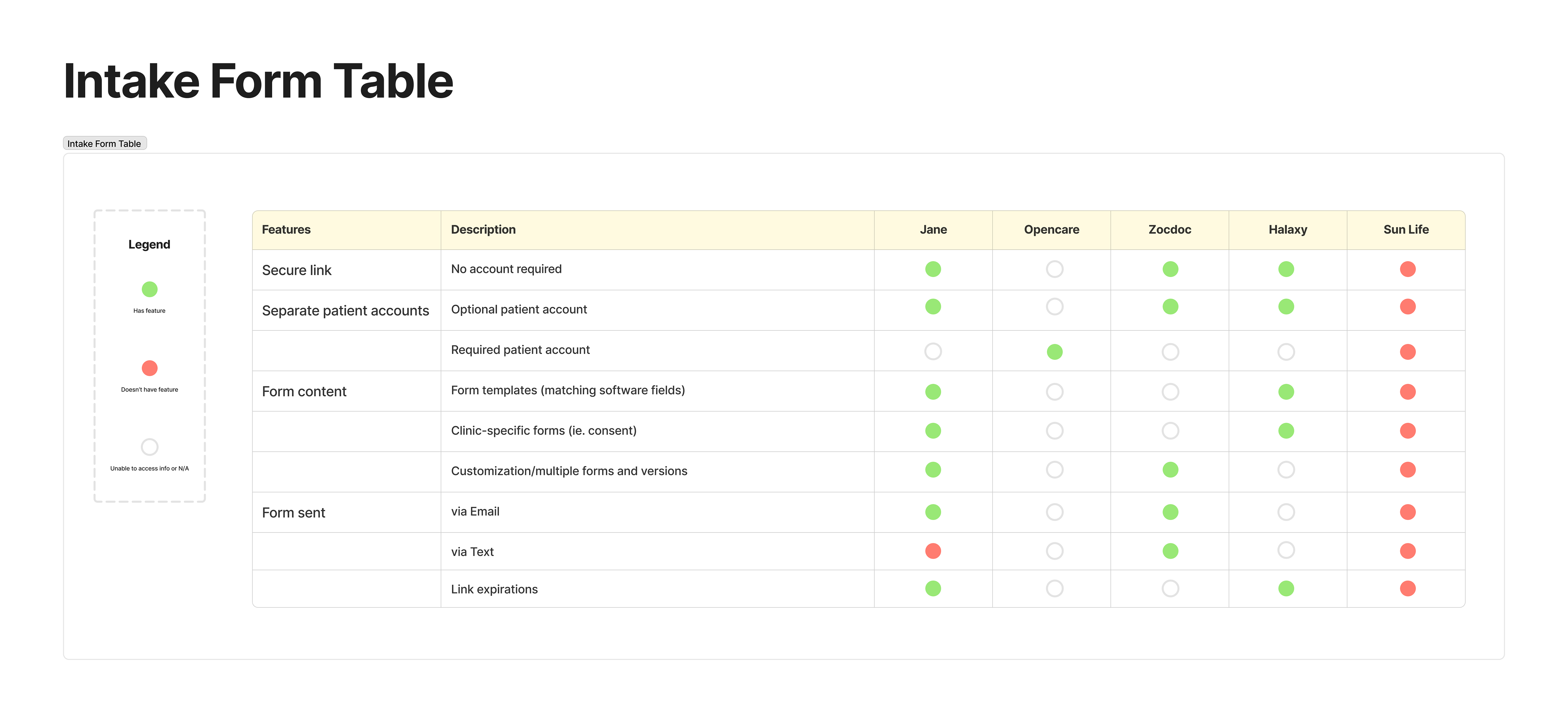
One potential feature the UX writer and I explored was adding an intake (provider) form in SLC, allowing providers to complete their own information. This would reduce the workload for facility admins, who otherwise have to gather data manually. The aim was to streamline the process and encourage users to update their profiles more easily. I created an intake form comparison table based on competitor analysis and developed three user flow variations to evaluate the solution's viability. These variations included facility admins initiating the forms, SLC initiating them, and leveraging Networks, which we were simultaneously working with on a disability project. After creating the user flows, I collaborated with the security team to ensure the feasibility of implementing intake forms.
Planning & discovery
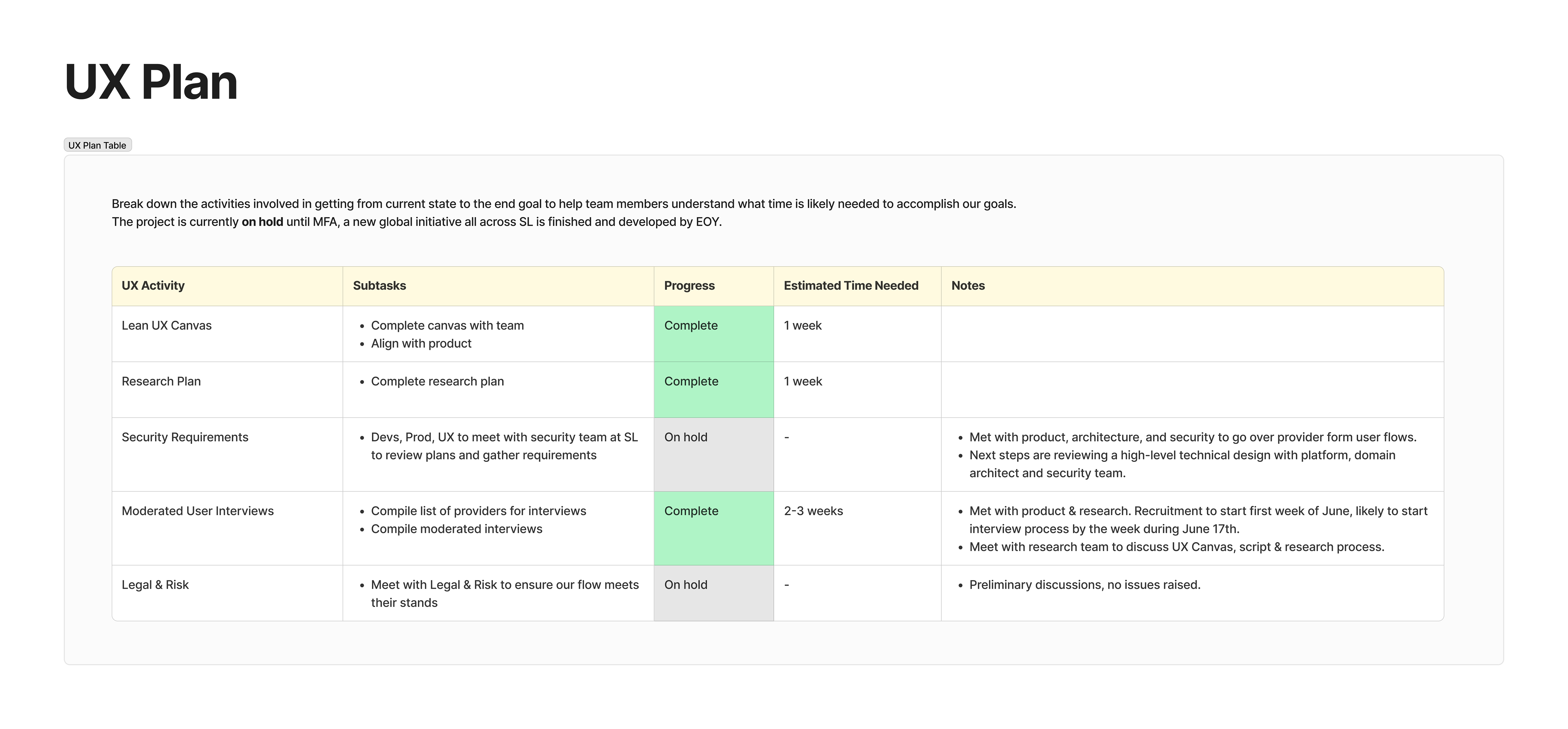
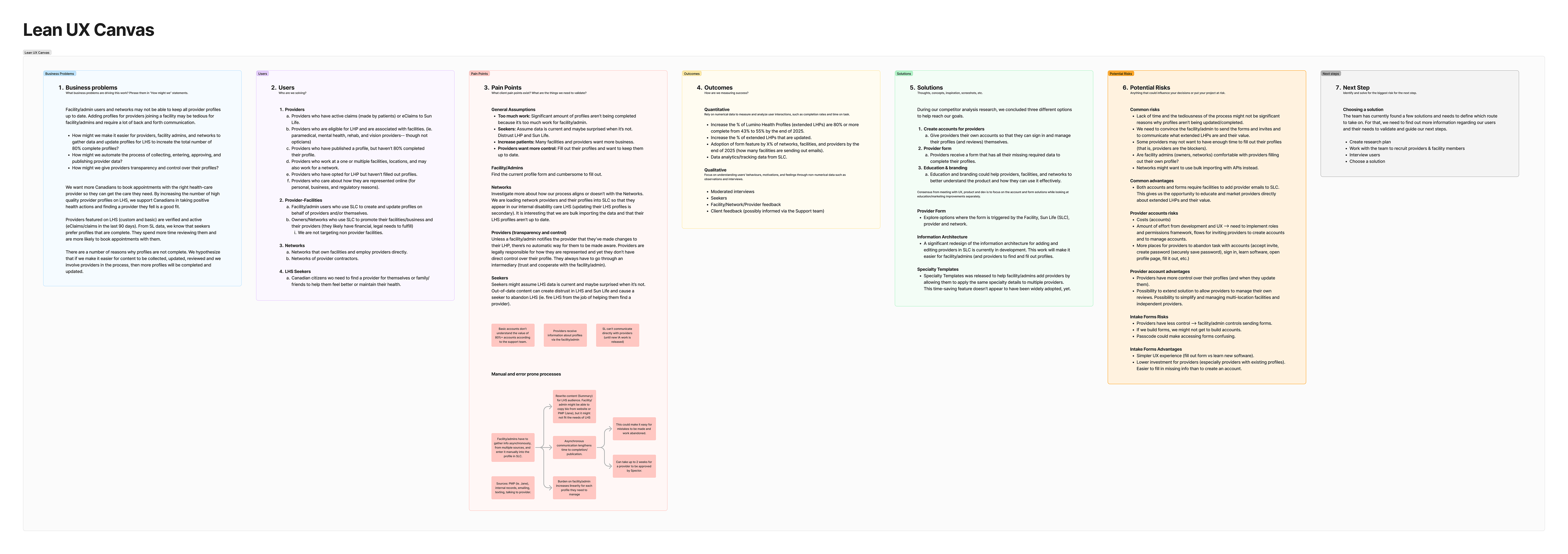
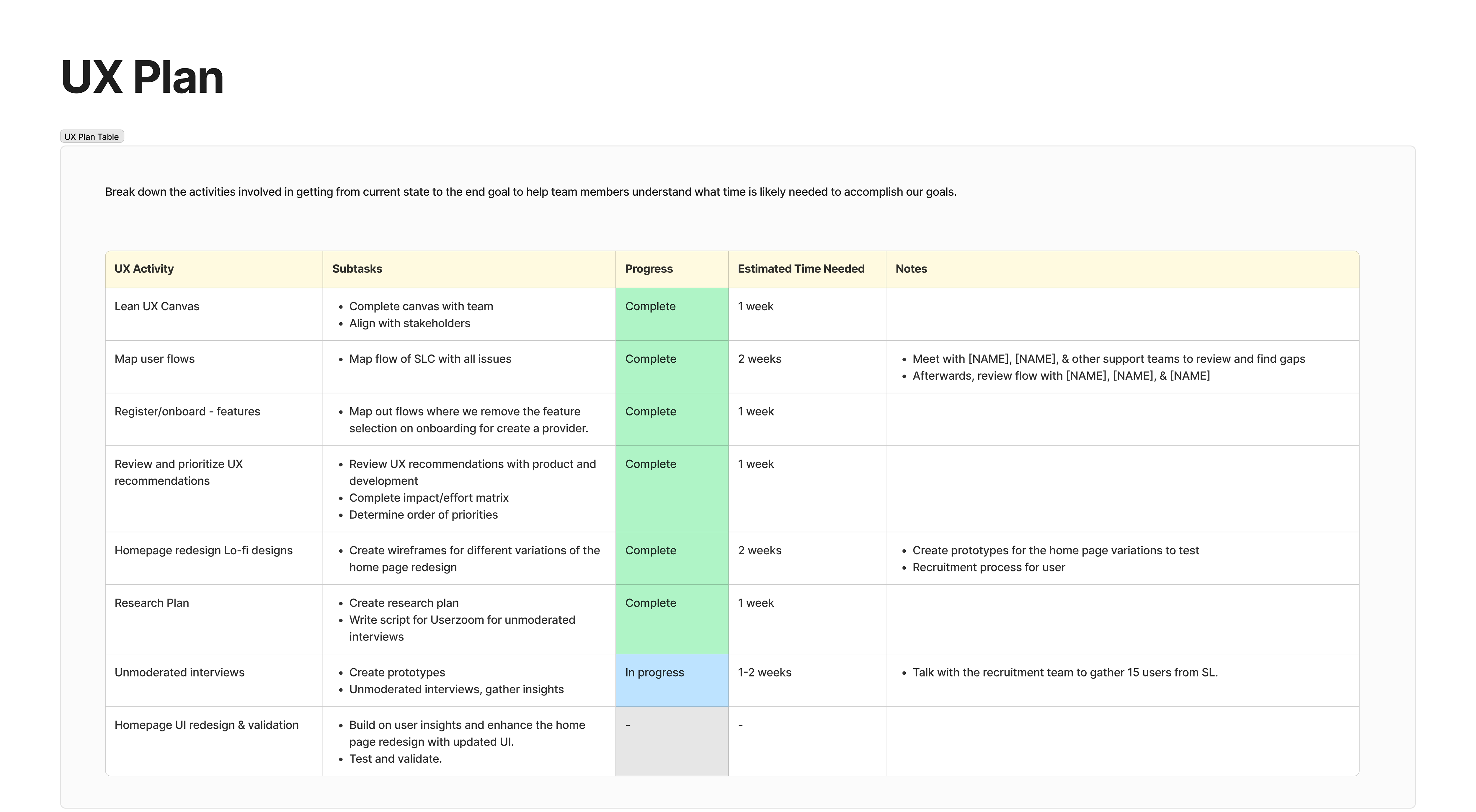
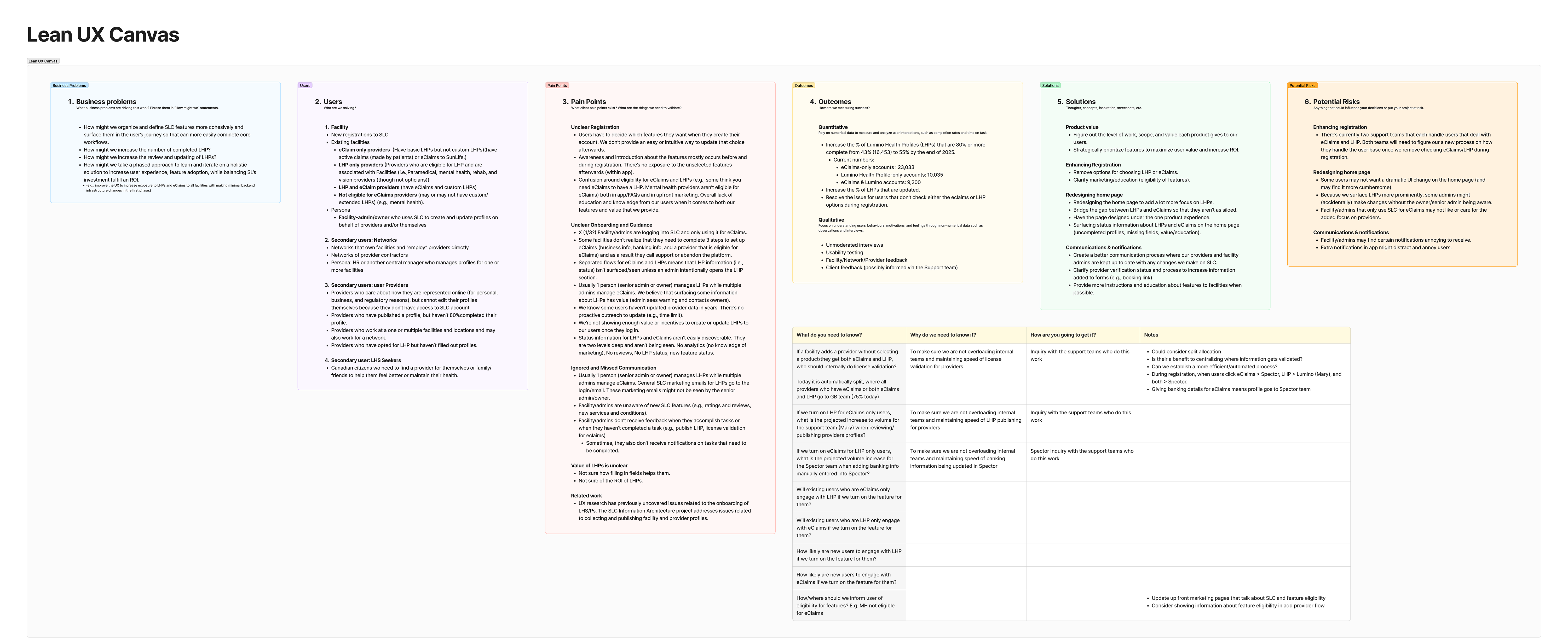
After our meeting, the next steps involved planning & discovery. I created a UX planning table and completed a lean UX canvas, categorizing essential aspects like business problems, users, pain points, outcomes, solutions, potential risks, and next steps. This process helped condense all research and insights into one comprehensive section before starting work on a research plan. I also included 2 of the 3 intake form user flows and the previous UX and technical table within the Figma file, ensuring we had all the necessary insights consolidated in one place for easy reference.
Research Plan
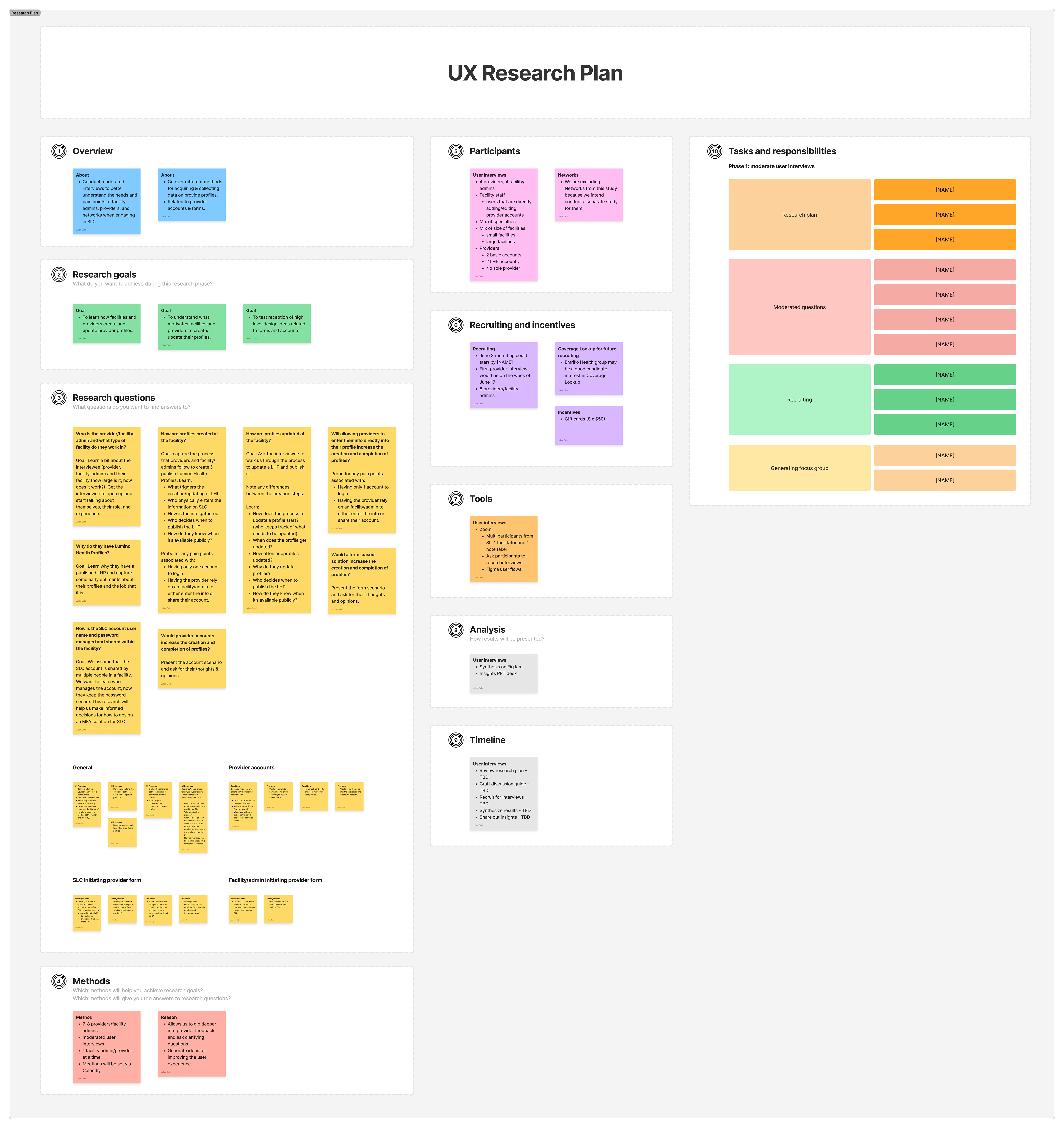
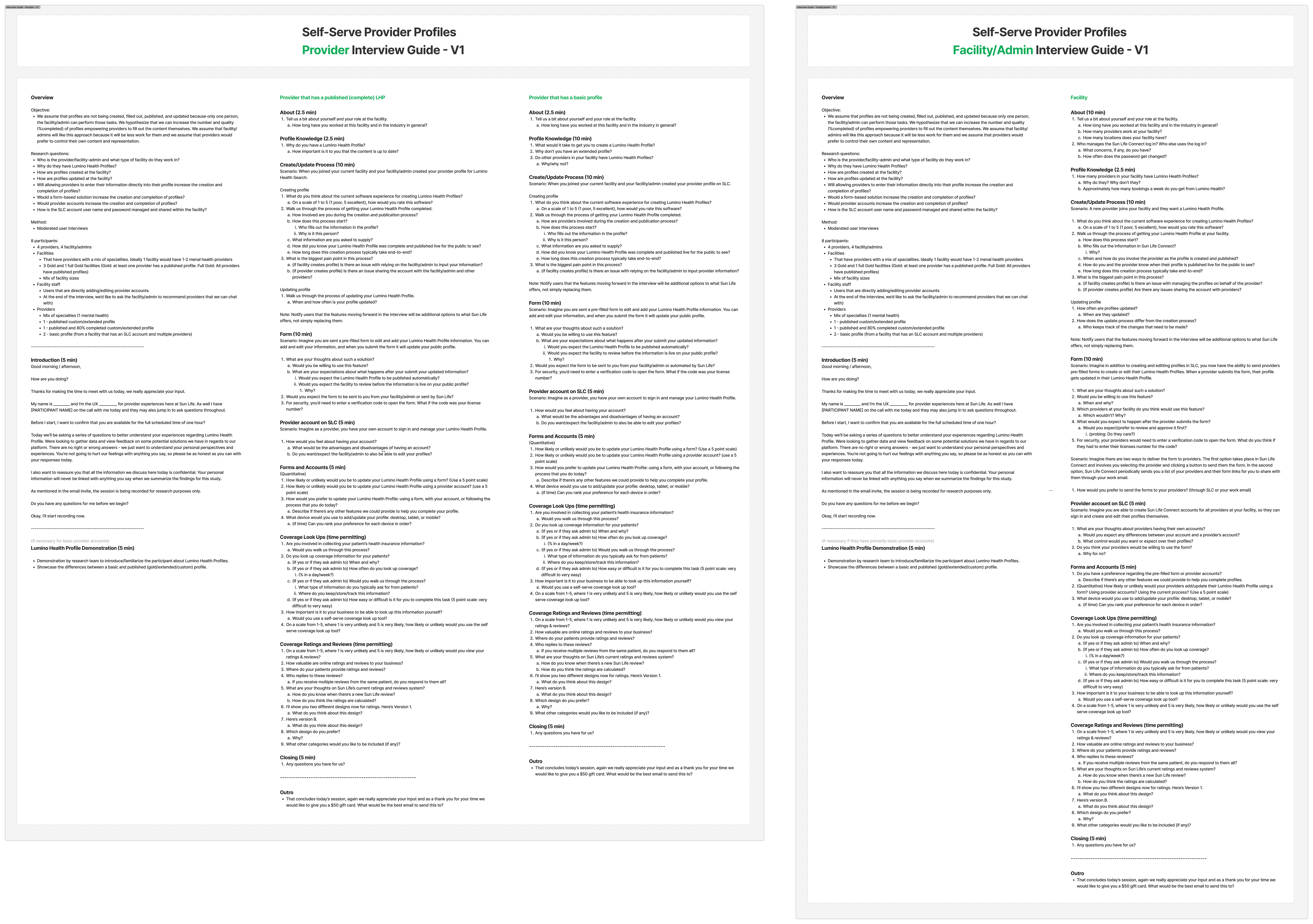
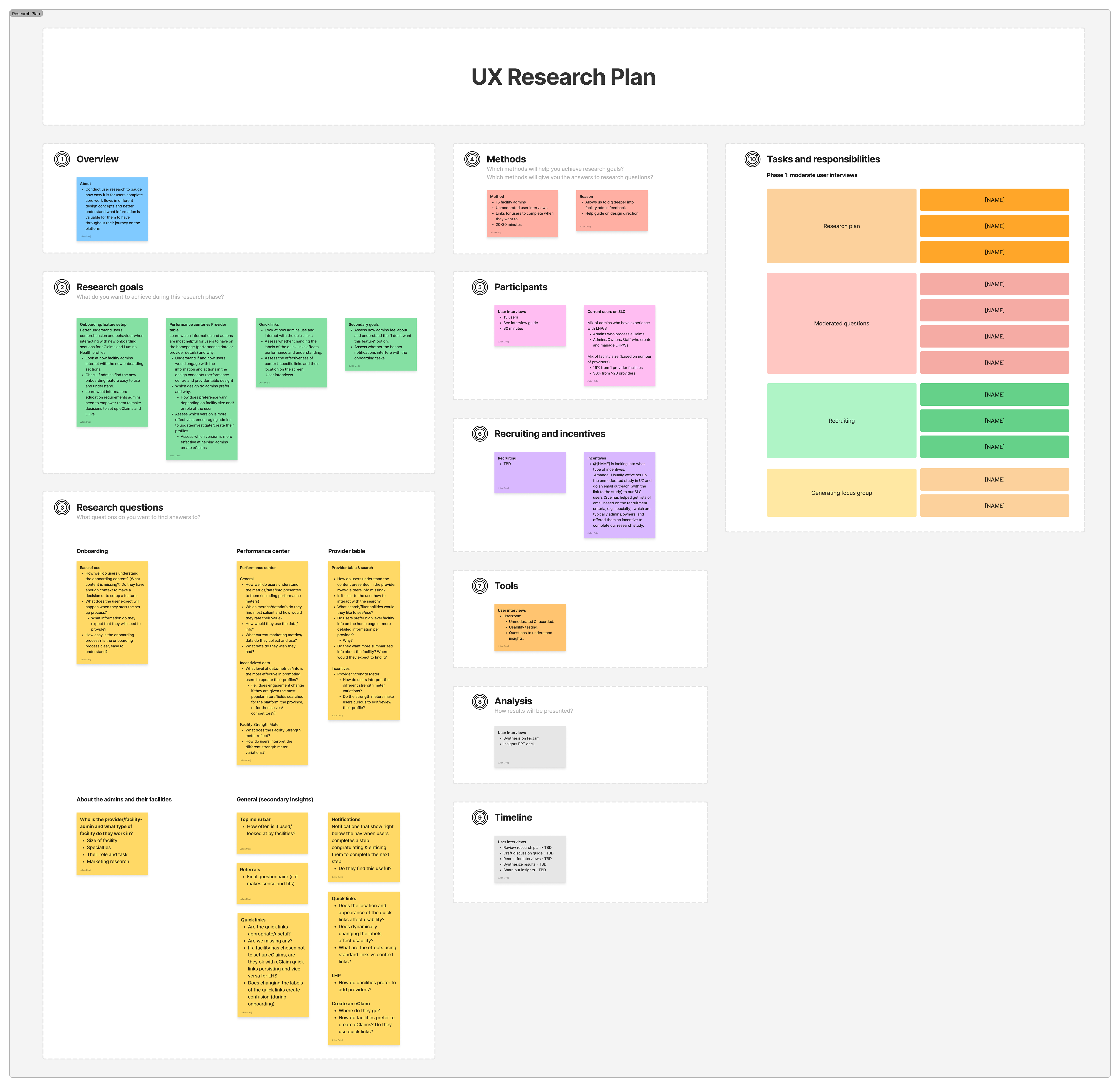
The UX writer and I developed a comprehensive research plan and wrote a script for a moderated interview with 8 different users. We collaborated with the recruitment team to determine the types of users to interview, and the research plan provided valuable guidance for their process. We created three separate interview scripts: one for providers with a published
Lumino Health Profile (LHP),
one for providers with a basic profile, and one for facility admins. Interviewing these three distinct groups was crucial, as their broader insights provided more value than focusing on a single group. The insights from the research were consolidated into a
research report
,
which played a key role in shaping the 1PX.
Although the business initially saw the provider accounts feature as a valuable way to increase profile completions to 80%+, the interviews revealed that users found little interest in this feature. Moreover, it was deemed too costly to implement, and the ROI was minimal. Therefore, it was not considered worth pursuing.
Intake forms
Intake (provider) forms were well-received by users. However, facility admins expressed a need to review the forms before any updated information was published. They also requested the ability to send personalized notes to their providers and set up reminders to complete the intake forms.
Education & branding
Our research revealed that we are not effectively educating facility admins on the value that SLC offers and how it impacts their providers' visibility on Lumino Health. Improved communication in this area is crucial.
Awareness
There is a significant gap in user awareness regarding the value we provide and the data we possess. Users are not fully informed about how this data can benefit them, highlighting the need for better education, enhanced notifications, and a focus on displaying critical information more effectively.
Lack of communication
Although users are completing certain actions on the platform, there is insufficient feedback or notifications to keep them informed of their progress or the status of their tasks. Improving communication with users is essential.
Inefficient home page
The home page is largely underutilized, with users primarily visiting it to submit eClaims or add/delete a provider. The page fails to highlight other valuable features, making it a key area for improvement.
Conclusion: Pivoting into 1PX
After analyzing the research from the competitor analysis, discovery, and planning phases, I concluded that the project's initial scope was too limited. Rather than focusing on implementing a single product or feature, the team needed to approach this as a holistic experience. By targeting a broader range of users and introducing features that build on one another, we could achieve a far greater impact. This approach would provide significantly more value to our users, beyond just encouraging facility admins to update their provider profiles, by creating a comprehensive and interconnected experience.
Early design process on 1PX
At this stage, we were ready to start the 1PX initiative. We identified several projects under the 1PX umbrella to determine the scope, workload, and potential value for our users. Our focus centered around five key areas:
Enhancing the Add a Provider flow
Redesigning the Home Page
Improving Communications & Notifications
Developing Intake Forms
Implementing Coverage Lookup
After presenting our findings to the business team, we proceeded with the planning & discovery phase. I created a detailed UX planning table and completed a lean UX canvas to structure our approach moving forward.
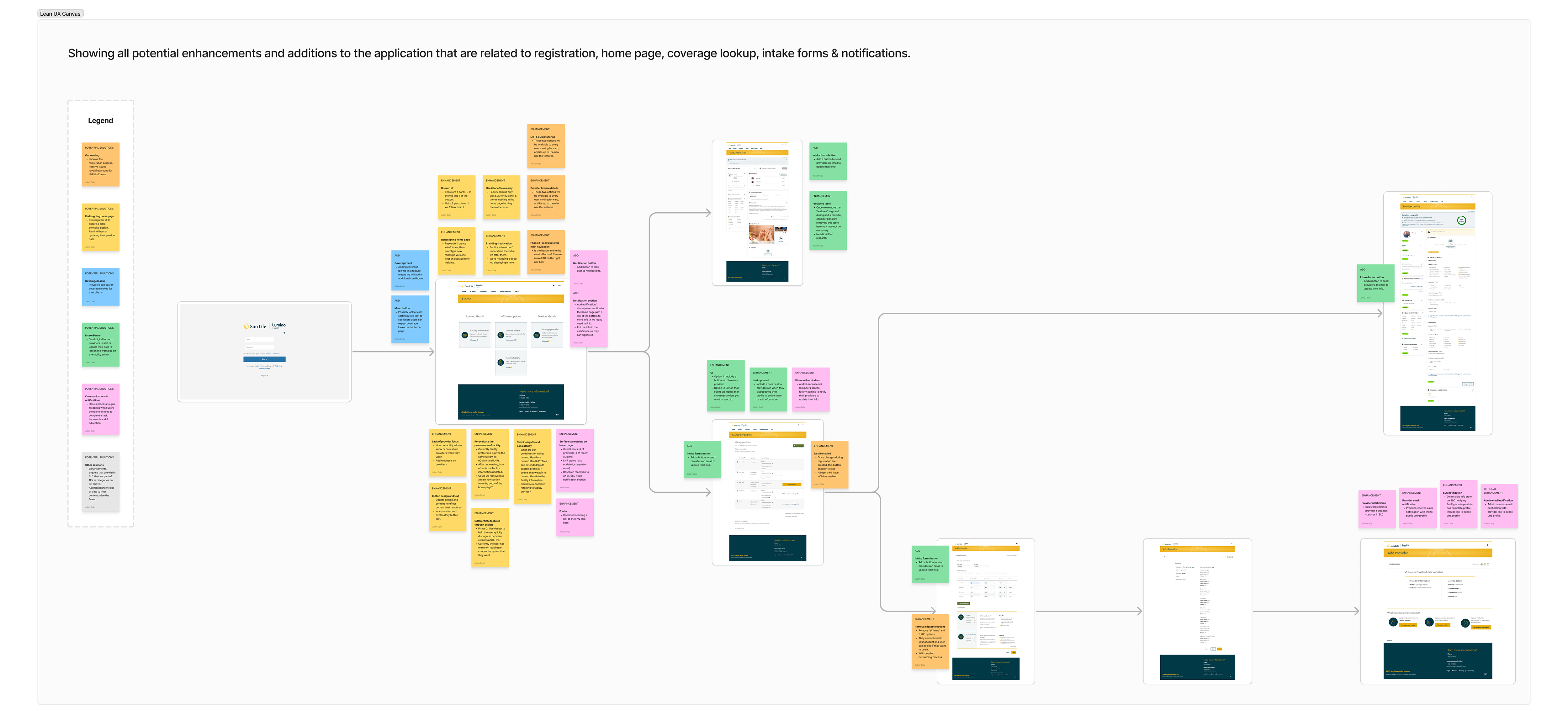
I mapped out the entire SLC application to gain a comprehensive understanding of the user journey across our platform. I then created five different colored stickies, each representing one of the key areas of the 1PX experience. I added stickies relative to each key area all across the user flow to get a better understanding of all the pain points and potential enhancements to measure which areas we needed to tackle first. After presenting this to the business, support, and marketing teams, we decided to focus on improving the Add a Provider flow and redesigning the Home Page as part of Phase 1. Communications & Notifications would also see gradual improvements over time, adjusted depending on the feature we were working on.
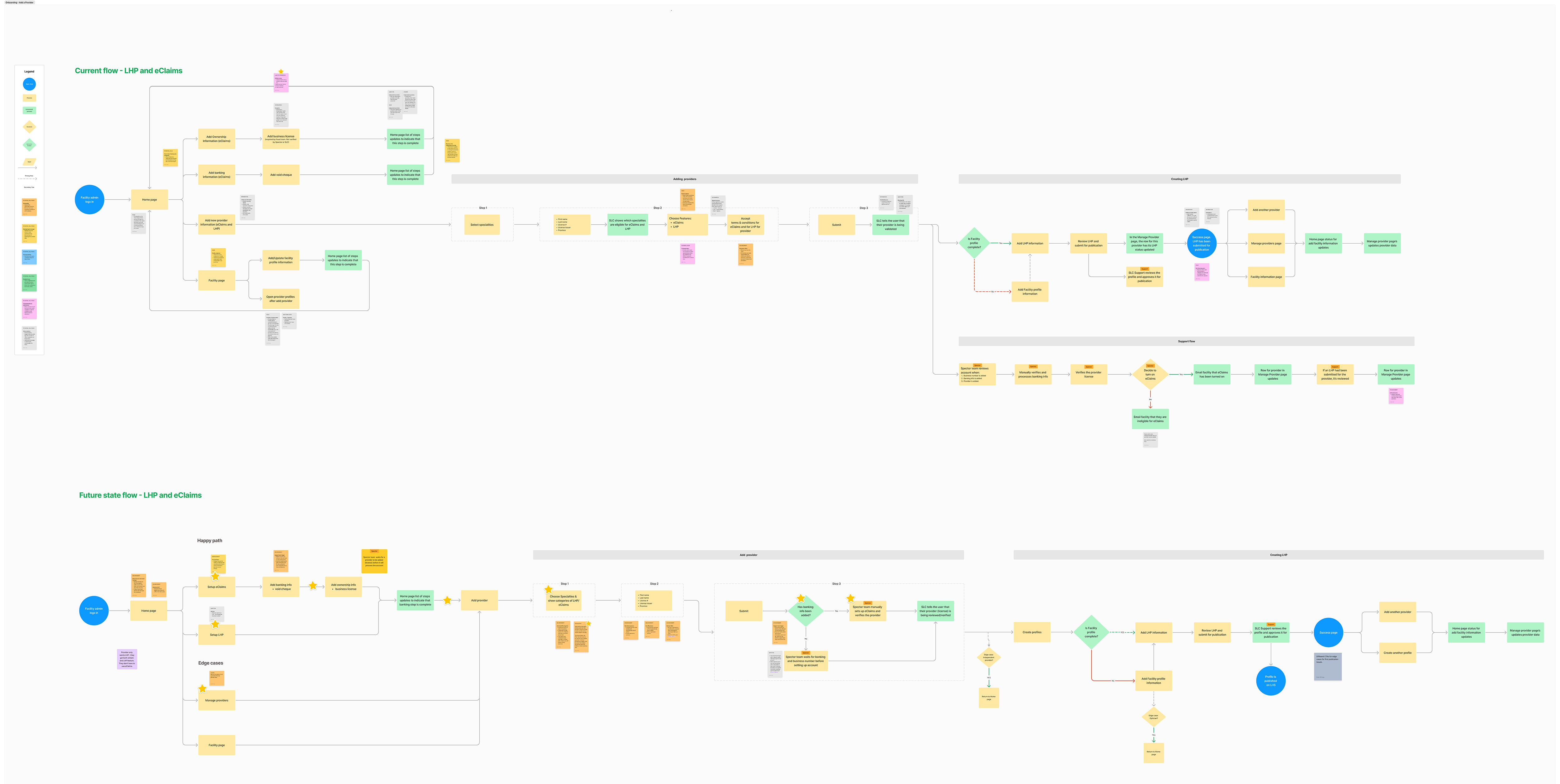
The first key area of focus was the Add a Provider flow. SLC offers facility admins the option to "opt in" for either LHP and/or eClaims, depending on the provider's specialty. Some specialties are eligible for only one option, while others qualify for both. A significant issue we discovered was that admins often overlooked the option to opt in during this process, and our platform did little to guide them after the fact. Many valuable features remained unused simply because users were unaware of them.
I developed both the old and new variations of the registration and Add a Provider flows, automatically opting eligible users into both features, allowing admins to adjust these settings later if needed. I reviewed the changes with the business and support teams to help categorize which users each team would assist, as the triggers during the flow had shifted. This feature has the potential to make an early impact on the app without requiring extensive resources or development time.
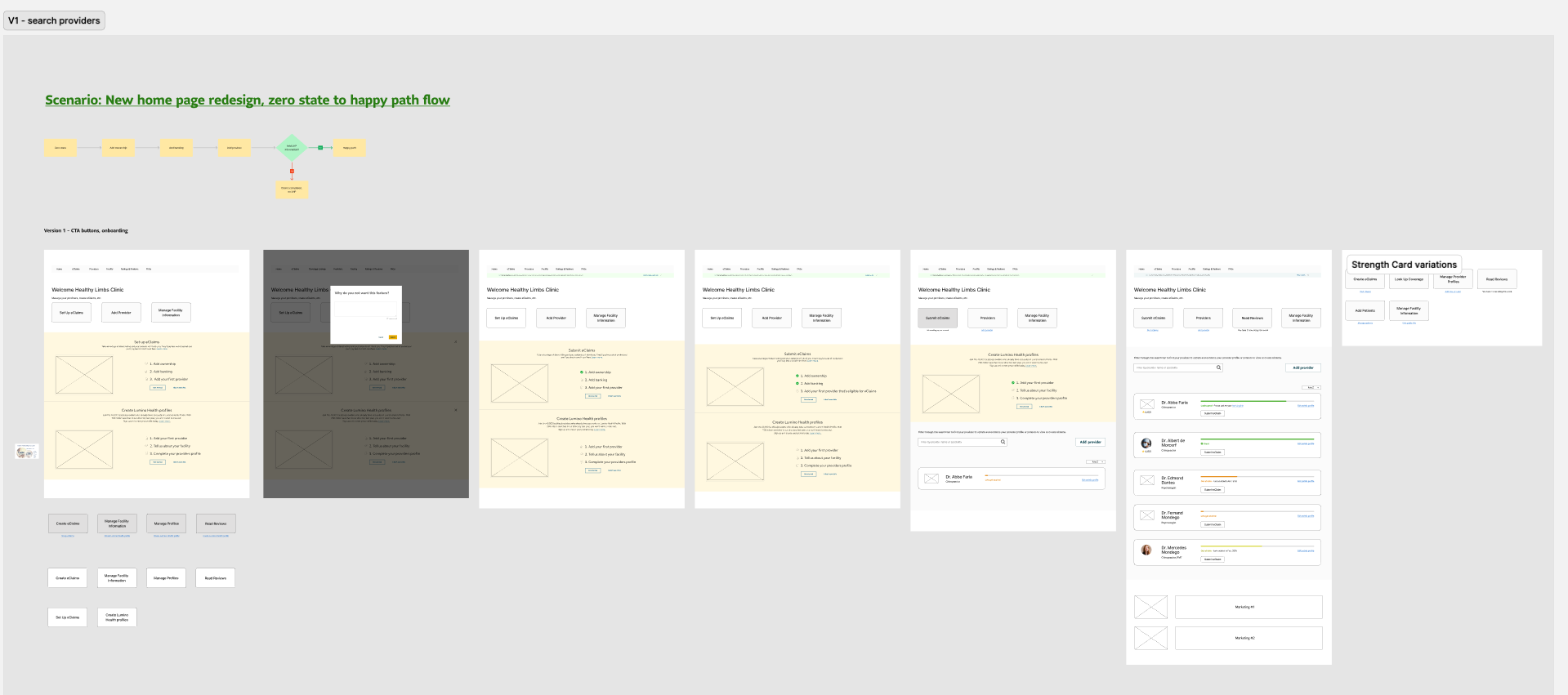
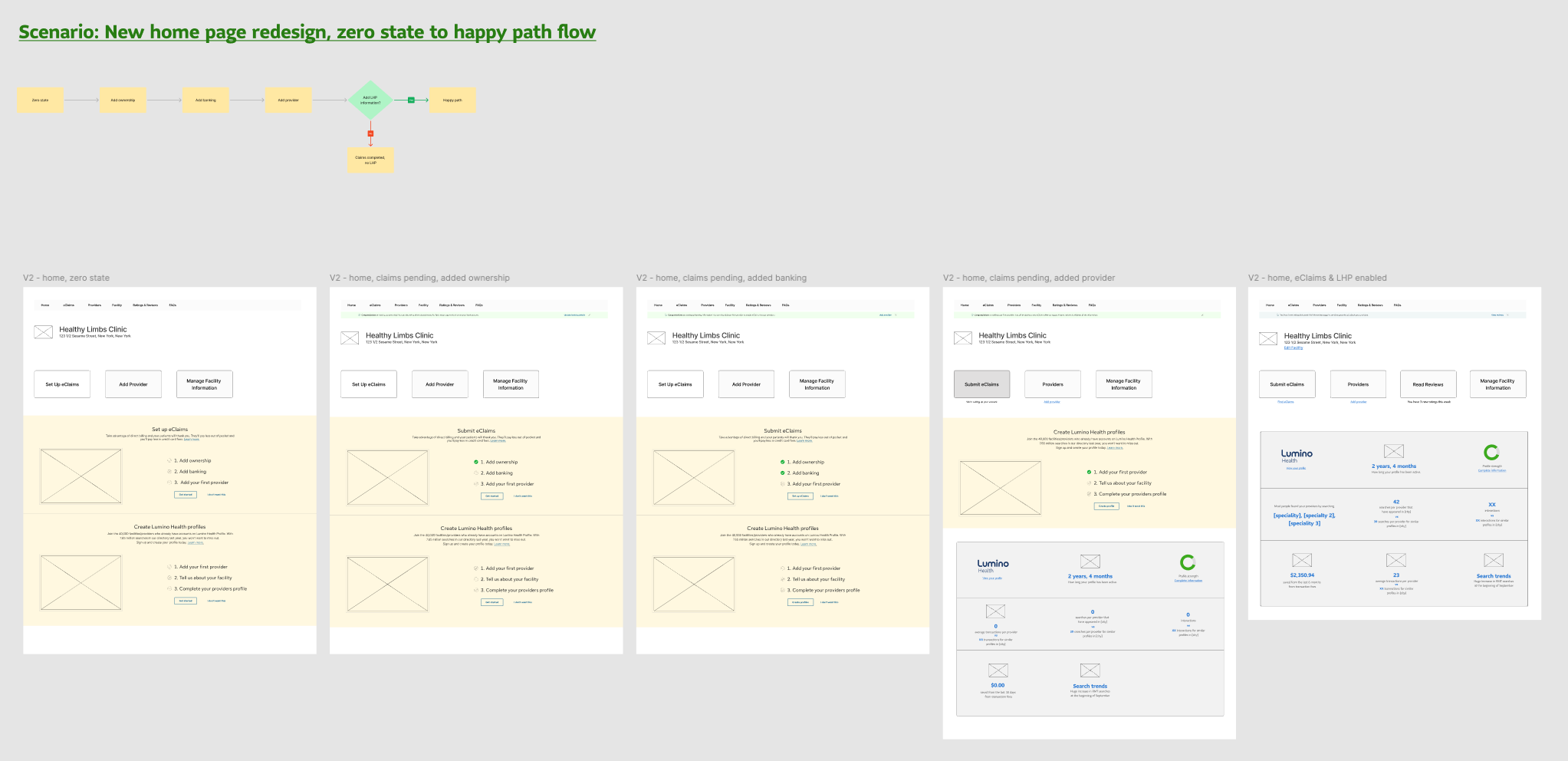
The next major focus was the redesign of the home page. After sketching many design ideas, I developed two main variations: the Provider Table and the Performance Center. Both versions featured dynamic CTAs below the nav, which dynamically changed depending on the user's status. For instance, during the eClaim process, once a user begins by adding ownership, banking information, and their first provider, there's an interim period where support staff review and confirm their information. During this time, the CTA shifts from an active "Set up eClaims" button to a disabled "Submit eClaims" button with a message below stating, "We're setting up your account." After approval, the CTA switches back to active.
Research over the last decade has shown that personalization is a significant driver of user engagement and urgency, which informed the dynamic nature of these CTAs. Additionally, I designed two onboarding experiences for LHP and eClaims. This would guide users through a more simplified, step-by-step process for setting up both features.
Two variations
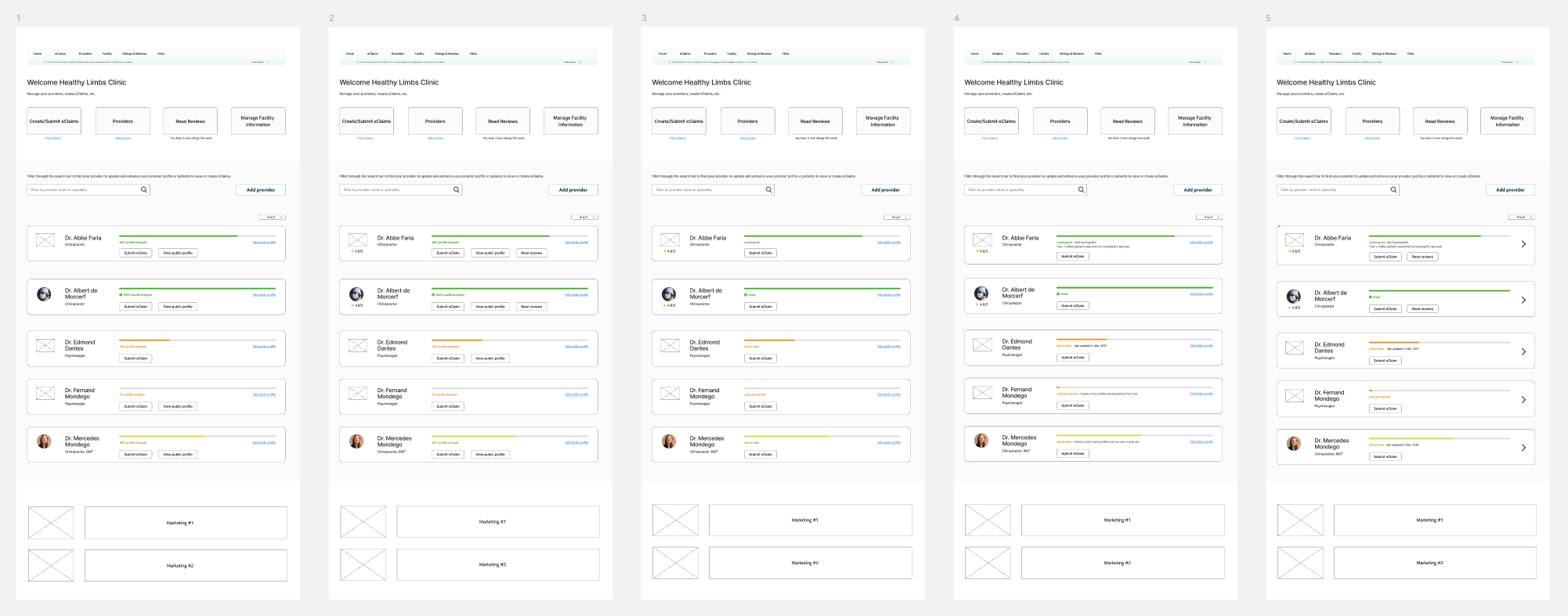
The provider table was designed to put providers front and center for facility admins. This variation included features that allowed admins to submit eClaims more efficiently by starting the process with the specific provider. It also displayed important information such as provider ratings and a strength meter for their provider accounts. The goal was to make provider-related data more prominent and easily accessible, enticing admins to review and update the data regularly. This was driven by the pain point that users often ignored provider data unless they were actively adding a new provider, as they did not see enough value in maintaining this information.
The performance center focused on providing useful data about the facility and its providers, helping admins understand the value of SLC and how it benefits their operations. It aimed to educate users on SLC's full capabilities and reinforce the Sun Life brand. The design was also gamified, allowing admins to compare their facility's performance against others in their city, further motivating engagement and interaction with the platform.
The UX writer and I developed a research plan and crafted a script for an unmoderated interview with 15 users using Userzoom. Our goal was to gather insights on the home page redesign. I have prepared wireframes and am currently working on prototypes for testing, focusing on a few key components we want to better understand:
Which of the two versions added more value to our users?
Pain points, insights, motivations for both versions.
How was the onboarding process for eClaims and LHP?
(secondary goal) Understanding of the CTAs at the top.
(secondary goal) Value of the notifications below the navigation.
The early design phase of the 1PX initiative focused on strategically enhancing key user flows and elements within the SLC application to boost engagement and streamline UX. By identifying core projects such as the Add a Provider flow and Home Page redesign, we prioritized efforts based on user pain points and potential impact for Phase 1. The initial focus on improving the Add a Provider flow aimed to simplify the onboarding process for admins, helping them fully utilize platform features through automatic opt-ins and adjustable settings. Concurrently, the home page redesign explored dynamic, personalized CTAs and two design concepts: the Provider Table and Performance Center to increase accessibility and engagement with provider-related information and facility performance data.
Through mapping exercises and close collaboration with business and support teams, we decided to begin with the high—impact Add a Provider and Home Page enhancements in Phase 1, while also planning iterative updates to Communications & Notifications. With research underway through Userzoom, we aim to validate our wireframes, refining them to align closely with user needs and improve the value to our SLC users.
Achievements
Self-serve solution
After conducting a thorough competitor analysis, we considered three potential solutions: provider accounts, intake forms, and education/branding. Interviews with facility admins and providers revealed that users found limited value in the provider accounts feature. While education and branding were important, they could be addressed through the broader IPX initiative. However, most users showed interest in the intake forms during the interview, though it would require some additional implementation and notification features to elevate its impact.
Holistic experience
Following further research and moderated interviews during the self-serve project, we pivoted from focusing on individual features to adopting a more holistic experience for SLC. This shift was a crucial step toward taking a broader view of the platform. I developed a plan that introduced features and enhancements that build upon each other, ensuring a more integrated and impactful experience rather than small-scale, isolated improvements.
Education & branding
One major insight from our research was that users were unaware of the full value we bring to their facilities. We had not done enough to educate them on how SLC benefits their facilities. To address this, we introduced helpful notifications, a strength meter, a home page redesign, and key statistics across the app to demonstrate the platform's value more clearly.
Feature selection
When a facility admin adds a provider, they are given an option to opt in for eClaims and/or LHP when the specialization is eligible for those features. Users sometimes wouldn't click those features during provider registration, and would never opt in for them at a later date. We removed the option to opt in so users can opt in at any point in the home page whenever they log in.
Onboarding
Redesigned a new onboarding experience to make it easier to understand what is needed for setting up both eClaims and LHP. This new process also guides them through steps for completing ownership, banking and adding a new provider as a collective experience rather than being separate components. This guides users to complete all 3 actionable items at the same time.
Value
Throughout research, testing, and interviews, we learned that users don't see enough value in our products. A big focus on 1PX was looking at a holistic experience to implement in key areas. A big focus was also to use information and data we have to show our users why our platform is crucial for their business.
Moving forward
Unmoderated testing: Usability and A/B testing on Userzoom regarding the home page redesign. Figure out key areas such as onboarding, as well as understand the value, pain points, and motivations of both design variations. Understand secondary goals such as notifications below the nav and the four quick link CTAs at the top of the page.
Monitor changes: After the features are developed, monitor user actions and research how they are reacting to the updated changes of onboarding and the home page redesign.
Phase 2: Intake form: Implement this feature and continue to monitor impact post release.
Phase 3: Coverage Lookup: Planning and discovery along with a reasearch plan and testing to understand the value of the feature. If it's a valuable feature, create user flow, designs, test, iterate and monitor post release to understand impact.